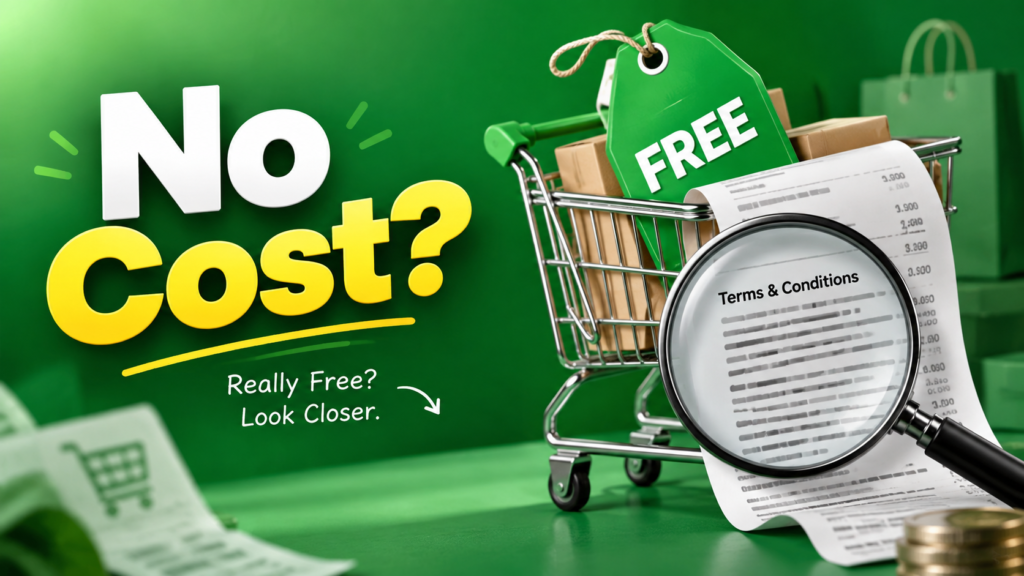
Short answer: Usually not. In most no-cost EMI offers, the interest still exists. A discount from the merchant or brand cancels it out. That can be a fair deal, but only if the other charges are small and you weren’t going to get a better price by paying in full.
Educational information only. This is not personalised financial advice, and no card or bank is being recommended.
What “no-cost EMI” actually means
Take a ₹60,000 laptop on a 6-month EMI. A bank normally charges interest on this. In a no-cost offer, the interest is calculated and then offset by an upfront discount, so the amount you pay across all instalments equals the product price.
RBI’s card rules push against disguising this. If an EMI has an interest component, it must not be passed off as zero interest. Issuers must also show the principal, interest and any upfront discount. The takeaway: look at the EMI breakup screen, not just the “No Cost” label.
Where the cost can hide
| Possible cost | What to check |
|---|---|
| GST on interest | The interest is still calculated, and GST may apply to it. Whether you or the seller bears it depends on the offer. |
| Processing fee | Often a flat fee plus GST. Some banks waive it during big sales, but don’t assume that. |
| A better instant discount you skipped | Many sales offer a bank instant discount for paying in full. It may not combine with EMI. |
| Rewards or cashback | Many cards exclude EMI transactions from points. Check your card’s terms. |
| Foreclosure fee | Closing the EMI early may attract a charge. |
| Credit limit block | The whole amount is usually blocked against your limit until you repay. |
A worked example (illustrative numbers only)
Assumptions: ₹60,000 laptop, 6-month EMI, an assumed 15% annual interest rate, a ₹299 processing fee, and 18% GST on both interest and fee. Real rates and fees vary by issuer, so treat these as a teaching example.
| Item | Approx. amount |
|---|---|
| Interest over 6 months (at 15%) | ₹2,650, cancelled by the upfront discount |
| GST on that interest (18%) | ₹480 |
| Processing fee + GST | ₹350 |
| Extra you actually pay | about ₹830 |
Now compare with paying in full. Suppose your card also offers a ₹2,000 instant discount for full payment:
| Option | What you pay |
|---|---|
| No-cost EMI | ₹60,000 + ~₹830 = ~₹60,830 over 6 months |
| Pay in full with ₹2,000 instant discount | ₹58,000 today |
The EMI leaves cash in your account for six months, which has real value if you need the flexibility. But in this example it costs about ₹2,800 more than paying upfront. Run your own numbers, because your offer will differ.
How it can affect your credit profile
- Utilisation goes up. If a ₹60,000 EMI is blocked on a ₹2,00,000 limit, that single purchase uses 30% of the limit. Many people treat 30% as a comfortable ceiling. That is a general rule of thumb, not an RBI rule.
- Repayment gets reported faster. From 1 July 2026, lenders report to credit bureaus on a weekly incremental basis. A missed EMI can show up sooner than it used to, and so can timely payment. How an EMI conversion appears on your report can vary by issuer.
Five checks before you tap “Confirm”
- Open the EMI breakup. Note the principal, interest, discount, processing fee and GST.
- Compare with the pay-in-full price. Look for instant discounts and bank offers.
- Add up your total outflow. Sum of instalments + fees + GST, minus any discount.
- Check your available limit. Will the block leave room for other spending?
- Check rewards exclusions in your card’s terms.
When no-cost EMI can make sense
- The pay-in-full price is the same (no extra instant discount exists).
- The processing fee is waived or tiny.
- You genuinely need the cash flow and can pay every instalment on time.
- You were already going to buy this item.
Mistakes to avoid
- Buying something extra because the monthly number looks small.
- Stacking several EMIs and forgetting the total.
- Treating “no cost” as “no risk”. A missed instalment still means late fees and interest, and may hurt your credit record.
The bottom line
No-cost EMI is a payment convenience, not free money. Check the breakup, do the two-minute comparison, and pick the option with the lowest total outflow that you can repay comfortably.
Save this checklist before the festive sales begin, and share it with someone who’s about to buy a phone on EMI. Follow EarnSphere for more plain-language money guides.
FAQ
Q1: Is no-cost EMI really free?
A: Usually not. The interest is typically offset by a discount, so the instalments add up to the product price. GST, processing fees, lost offers or rewards exclusions can still add cost.
Q2: Does no-cost EMI affect my credit score?
A: It can indirectly. The purchase amount is generally blocked against your credit limit, which raises utilisation, and repayment behaviour is reported to bureaus. How it is shown varies by issuer. Verify in your own credit report.
Q3: Is no-cost EMI better than an instant discount?
A: It depends on the total outflow. Compare the pay-in-full price after discounts with the EMI total including fees and GST. Choose whichever costs less and fits your budget.
Q4: Can I close a no-cost EMI early?
A: Often yes, but a foreclosure charge may apply. Check your issuer’s terms before you accept.
Q5: Do I earn reward points on EMI purchases?
A: Many cards exclude EMI transactions from rewards. Check your card’s reward terms.